
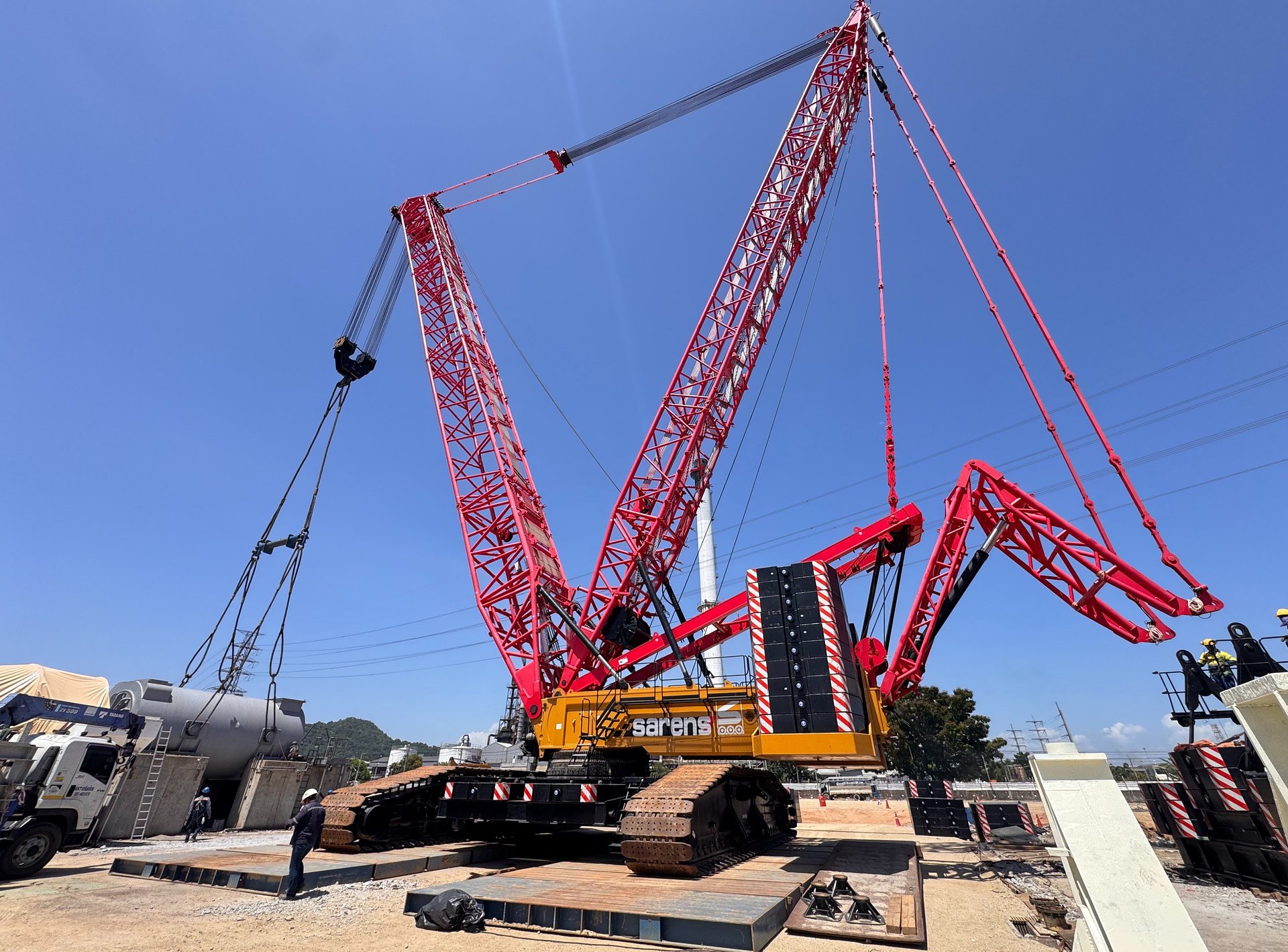
Sarens provided a SANY SCC8000A crawler crane,, with a 350-ton superlift counterweight, together with a Tadano GR-700EX rough-terrain crane, to support the dismantling of the old power plant facilities.
The works took place within an operating industrial complex, requiring strict compliance with site safety rules, approved lifting plans and work permits, alongside close coordination with the dismantling contractor.
Sarens, world leader in heavy lifting, engineered transport and crane rental services, has been commissioned by its client U.S.T. industrial technology co. to provide lifting support and demobilization services as part of the dismantling of the GPSC Old Power Plant Project at the Thai Oil site in Sriracha, Chonburi, Thailand. The project aims for the safe removal of obsolete power plant structures and equipment, helping to prepare the industrial area for future use while reducing the risks associated with ageing facilities.
Ahead of mobilization, Sarens' engineering team carried out a detailed study of the site to define the lift sequencing and the exact crane positioning, taking into account ground conditions, access routes and the working radius available within the plant. Because the dismantling work was to take place alongside ongoing demolition activities, particular care was also given to defining exclusion zones and coordinating the lifting schedule with the client's site permit system, so that both operations could run safely in parallel without disrupting one another. This stage of the project also required strict compliance with Thai Oil/GPSC's site safety rules, with every lift governed by an approved lifting plan, the relevant work permits, and clearly defined exclusion-zone controls, all of which were managed in close coordination with the dismantling contractor.
After the site study, Sarens deployed a SANY SCC8000A crawler crane in ZHDB configuration (230 + 80 t), with a 350-ton superlift counterweight, alongside a Tadano GR-700EX rough-terrain crane to carry out the works. The SCC8000A provided the capacity and stability required for the main dismantling lifts, while the GR-700EX offered mobility and flexibility for supporting lifts and work in tighter areas of the site. Throughout the project, both cranes performed reliably, providing stable, controlled lifting and supporting safe execution and efficient coordination with the site team.
The SCC8000A, GR-700EX, boom sections, counterweights, hook block, tackle and supporting equipment were mobilized by road from the Sarens Thailand yard to the Thai Oil site, a process that, including site entry, took approximately an estimated of 25 to 30 transport loads. While the GR-700EX needed only standard site preparation, bringing the SCC8000A into its ZHDB configuration with the 350-ton superlift counterweight was a more demanding process, with assembly, rigging, testing and commissioning taking around five to seven days to complete.
Working within an active industrial site added a further layer of complexity to this phase, as the Sarens team had to manage restricted access, coordinate continuously with the ongoing dismantling work, verify ground bearing capacity before positioning the crane, and adapt to changing lift conditions, all while maintaining strict compliance with the site's permit and safety requirements.
The project's critical lift involved the dismantled gas turbine and its support structure, weighing 334.5 tons, for a total lifted weight of 349.1 tons including the hook block and tackle, executed at a 26-meter working radius and a 4-meter lift height. The load was secured with a four-point sling arrangement, lifted vertically and kept level, then slewed under controlled conditions before being lowered directly onto a multi-axle transport trailer, with the SCC8000A remaining stationary throughout the maneuver. The operation was carried out by a team of approximately 10 to 12 crew members, including crane operators, riggers, signalers, lifting supervision, safety personnel and engineering support.
Operating inside a live industrial complex shaped much of the project's logistics. Crane positioning was limited by the surrounding structures and services, access routes had to follow designated paths through the plant, and every delivery and work permit required close coordination with Thai Oil/GPSC to avoid disrupting other site activities. As the demolition works coincided with Chonburi's summer season, the team closely monitored high temperatures—which posed a risk of heatstroke—as well as thunderstorms and strong winds. Lifting operations were immediately suspended whenever wind speeds exceeded crane lifting limits or weather conditions breached safe operating thresholds.
In recent years, Sarens has reinforced its position as a strategic partner for heavy lifting and dismantling operations in Thailand's energy and petrochemical sector. The company has marked key milestones in projects such as the dismantling of IRPC's DCC cyclone reactor at its Rayong plant, where it also handled the lifting and installation of the new unit while keeping the plant's shutdown time to a minimum; the safe dismantling of the PTT Asahi petrochemical plant in Map Ta Phut, deploying LR 1600-2 and CC 2800 crawler cranes to handle heavy components in congested areas, reinforcing Sarens' position as a long-standing partner for complex lifting and dismantling operations in Southeast Asia's energy sector.
About Sarens
Sarens is the global leader and reference in crane rental, heavy lift and engineered transportation services. With state-of-the-art equipment, value engineering, one of the world's largest inventories of cranes, transporters and special rigging equipment, Sarens offers creative and intelligent solutions to today's heavy lifting and engineering transport challenges.
With more than 100 entities in 70 countries operating without borders, Sarens is an ideal partner for small to large-scale projects. Sarens currently employs 6,500 highly qualified professionals who are ready to serve the needs of any client worldwide and in all market sectors. https://www.sarens.com/