
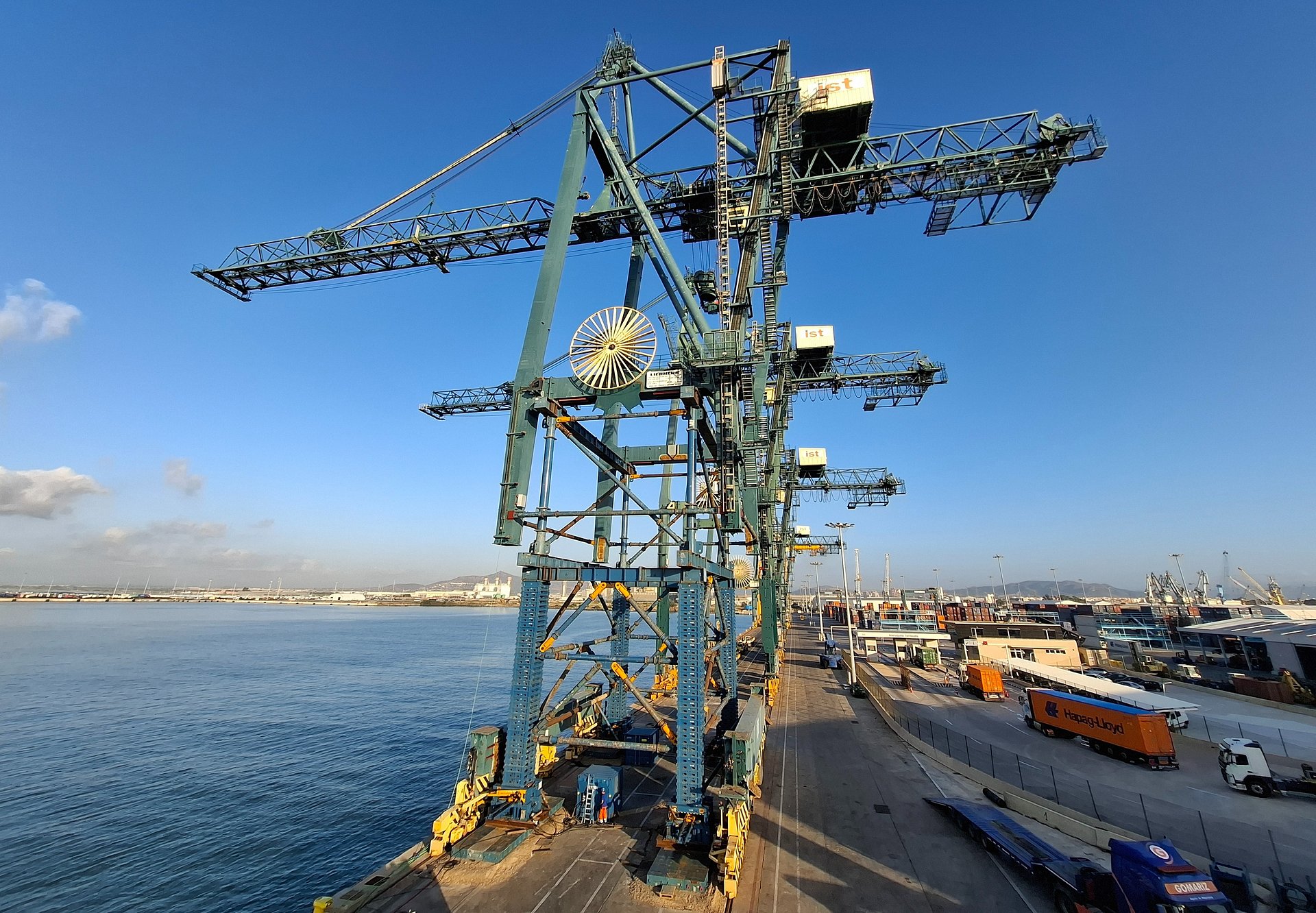
The operation was a pioneering project, as it had never been done before with the CS350 system selected by the Sarens engineering team to carry out the work. Stability had to be thoroughly checked, especially given the COG (center of gravity) position (42 meters above ground level).
Sarens' engineering team selected four CS350 system bases for this work due to their capacity and stability. The bottom-feed design of these systems offers unique advantages, as there is no need to work at height, unlike with top-feed systems which require elements to be installed and removed.
Sarens, world leader in heavy lifting, engineered transport and crane rental services, has recently carried out an innovative heavy engineering project, jacking up two STS (Ship-to-Shore) cranes on behalf of its client Quality Futura at the Intersagunto Terminales facilities in the port of Sagunto, Valencia (Spain). This terminal is the main container operator in the enclave, located at North Quay 2 and has approximately 640 meters of berthing line with an annual capacity of around 190,000 TEU (Twenty-foot Equivalent Unit). The port of Sagunto acts as a specialized complement to the Port of Valencia with container, general cargo, and bulk traffic, offering an alternative with good land connections for industries in the industrial and logistics environment of Sagunto and the Valencia–Teruel axis.
The scope of this project for Sarens involved lifting two STS cranes weighing 620 tons by 11 meters using synchronized hydraulic jacks supported at structural points. This allowed the crane structure to be lifted in a controlled manner and in accordance with the strictest safety controls. The operation was a pioneering project, as it had never been done before with the CS350 system selected by the Sarens engineering team to carry out the work. Stability had to be thoroughly checked, especially given the COG (center of gravity) position (42 meters above ground level). The position of the COG is key because it determines how the weight is distributed among the jacks, so before and during jacking, the configuration is adjusted to avoid uneven loads or instability.
The crane lift was necessary so that bigger and taller ships could be offloaded, allowing the company to fit extensions into the crane legs. Thanks to the additional 11 meters, the clearance height has been increased, allowing the terminal to operate ships with up to 9 or 10 levels of containers above deck, which is essential for continuing to operate on major modern trade routes. In turn, this expanded capacity will boost the terminal's handling capacity and operational efficiency.
Sarens' engineering team selected four CS350 system bases for this work due to their capacity and stability. The bottom-feed design of these system offers unique advantages, as there is no need to work at height, unlike with top-feed systems which require elements to be installed and removed at the top of the stack. This reduces health and safety risks for operators. Another unique feature of the CS350 is its ability to lift loads of up to six metres without the need for shoring. However, to lift above a 6-metre stack of elements, as in this case, a shoring system is required to stabilise the towers. There was also a metal structure at the top of the lifting towers, weighing around 100 tonnes and consisting of modular beams and support equipment.
In order to transport all the machinery and additional materials used, 16 trucks were needed from the Sarens yard to the port of Sagunto, where they were assembled in just 5 days. The equipment remained at the facility for 5 weeks. The main difficulty during assembly was fitting all the bracings, especially because the bracing system does not allow for adjustable heads, as they were all fixed length.
During the operation, Sarens' engineering team strictly monitored wind speeds to prevent them from exceeding the permitted limit. Adverse weather conditions, including days of intense heat exceeding 30°C and periods of heavy rain, prevented the procedures from being carried out. It took about two days to jack each crane to its final height, including fitting all the bracings. Six Sarens operators participated in this work.
Sarens' Technical Solutions KAM, José María Martínez, stated, "We are very proud of the work carried out at the port of Sagunto, a pioneering operation with the CS350 system that demonstrates Sarens' ability to undertake any kind of project. Thanks to the lifting capacity of the STS cranes, the port now has renovated facilities that allow it to compete for ships that were previously forced to go to larger facilities. In addition, we have managed to increase operational efficiency because having taller cranes reduces maneuvering time for large ships, which lowers costs for shipping companies."
Sarens has extensive experience in the development of technological innovation projects. Among other notable works, it stands out for the erection of the Spinlaunch launch chamber, the first rocket launch system that relies solely on kinetic energy, as well as the loading and transport of the foundation bases for the offshore wind farm in St. Brieuc, off the coast of Brittany, France.
About Sarens
Sarens is the global leader and reference in crane rental, heavy lift and engineered transportation services. With state-of-the-art equipment, value engineering, one of the world's largest inventories of cranes, transporters and special rigging equipment, Sarens offers creative and intelligent solutions to today's heavy lifting and engineering transport challenges.
With more than 100 entities in 65 countries operating without borders, Sarens is an ideal partner for small to large-scale projects. Sarens currently employs 6,000 highly qualified professionals who are ready to serve the needs of any client worldwide and in all market sectors. https://www.sarens.com/