
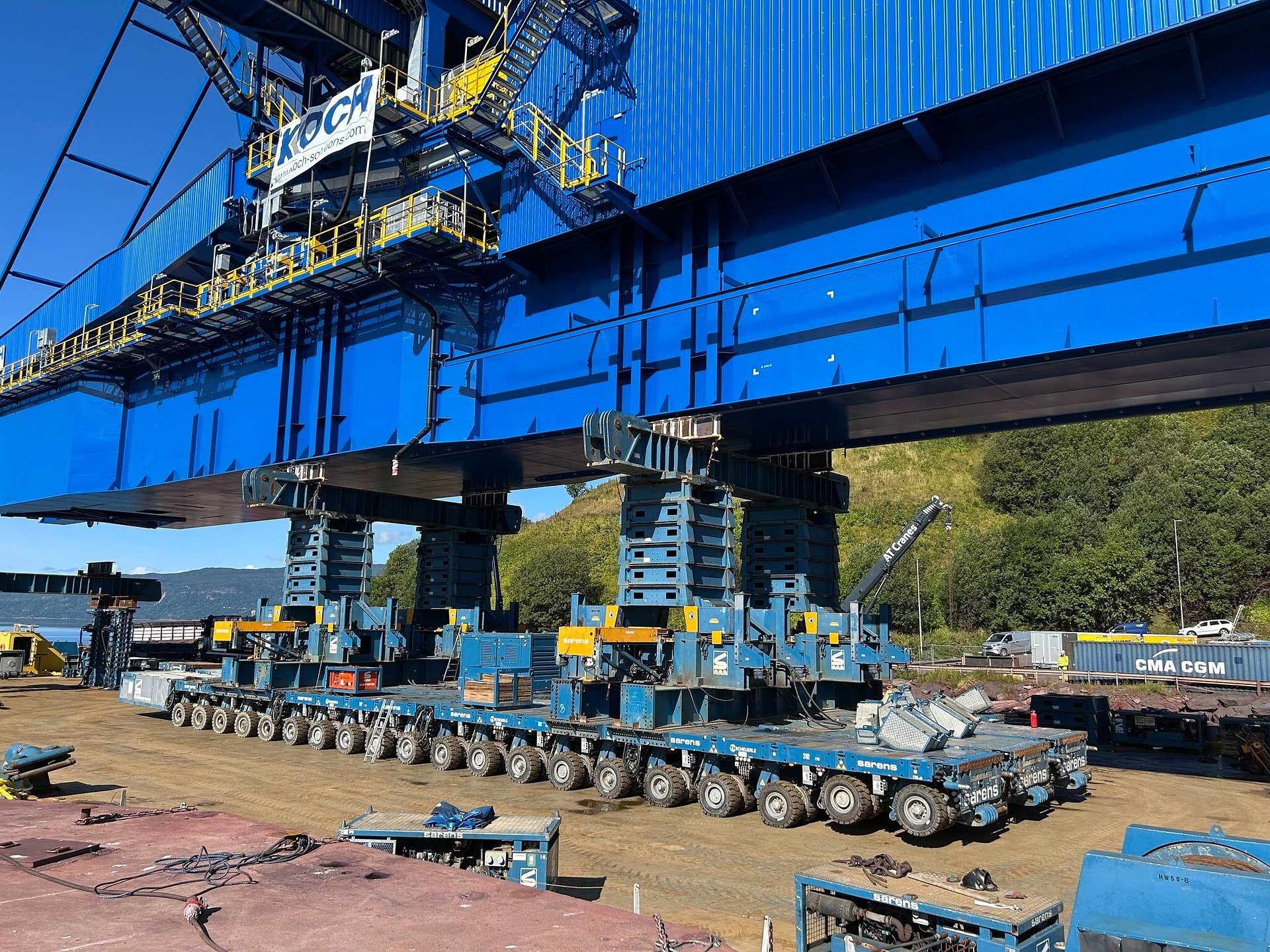
The project was carried out in two phases, beginning with the removal of the old shiploader, which weighed approximately 2,900 tons and dated from the 1970s.
Unlike the old model, which was an open structure, the new shiploader is completely enclosed. The conveyor belts and transfer points are encapsulated to prevent wind from dispersing iron dust into the city, which lies just a short distance from the port.
LKAB has been an integral part of the port Narvik handling around 20 million tons of iron ore products annually. The company has undertaken an ambitious investment program of SEK 5 billion to modernize the Narvik terminal, where the centerpiece was the replacement of the ship loader, which had been in operation since 1977.
Sarens, world leader in heavy lifting, engineered transport, and crane rental services, has been commissioned by its client Koch Solutions to replace LKAB´s 2.200 ton shiploader in the port of Narvik in a highly complex operation that showcases the company's ability to perform heavy lifting engineering operations of the highest standard. The port of Narvik, located in northwestern Norway, is a key hub for the export of iron ore to Europe. The state-owned Swedish mining company, LKAB, has been an integral part of the port for 120 years, handling around 20 million tons of iron ore products annually. The company has undertaken an ambitious investment program of SEK 5 billion to modernize the Narvik terminal, where the centerpiece was the replacement of the ship loader, which had been in operation since 1977.
The project was carried out in two phases, beginning with the removal of the old shiploader, which weighed approximately 2,900 tons and dated from the 1970s. To undertake this operation safely, the Sarens engineering team had to carry out several preliminary studies. For example, in order to verify the structural integrity of the shiploader, it was necessary to perform high-level engineering work, including 3D modeling of the shiploader and a full structural assessment. A 3D scan was also carried out to verify the as-built geometry and enable precise planning of the removal. The engineering also included analysis of the strength and stability of the barge, the SPMTs, the lifting system, and the mooring. With this in mind, Sarens' team chose to use 4 CS 1000 jacking systems, 4 CS 100 jacking systems, and 84 axle lines of Kamag K24-ST SPMTs.
The studies revealed that the shiploader structure required reinforcement to safely support and transfer the weight for removal, designed and coordinated by Sarens. The shiploader consisted of three main components, which were removed separately. The main body, weighing around 2,500 tons, was removed using four CS 1000 jacking towers positioned on a barge. The two remaining smaller components, the landside and seaside slewing points, each weighing around 200 tons, were driven on board using SPMTs. After removal, the shiploader main body was positioned diagonally on the barge on top of the jacking towers, and SPMTs were used to lift it from the jacking towers, rotate it, and set it down on the grillages.
The old shiploader will not be scrapped, but will be given a second life and reused by another company in the port of Gulen in Bergen for loading stone and gravel. Therefore, after removal, the shiploader was transported on the barge to the base of operations at Wergelandbase AS in Gulen, Norway. Once there, all three shiploader components were driven onto the quay using SPMTs and reinstalled using CS 1000 and SPMTs to continue operation at its new location.
The second phase of the project consisted of the loading, transport by sea to the LKAB yard, and installation of the new shiploader on site. This machine, built in Szczecin, Poland, weighs approximately 2,200 tons. In the first stage of the load-out and transport, at the fabrication yard in Poland, due to ground bearing capacity constraints, Sarens used load-spreading material beneath the SPMTs, consisting of steel structures combined with a gravel ramp, to distribute the load during the load-out operations on the barge.
As with the old one, the new shiploader consisted of three main components: the main body, weighing around 1,800 tons, and the land-side and sea-side slewing points, each weighing around 200 tons. In this case, however, only the main body and seaside slewing point were transported in fully assembled condition, and the seaside slewing point needed to be loaded in smaller components and assembled on site in Narvik. The main body and seaside slewing points were driven onto the barge using SPMTs, while the landside point components were loaded using a telescopic crane.
On arrival in Narvik, in a first phase the landside and seaside components were unloaded using SPMTs and a telescopic crane. The main body was jacked up using eight CS 450 jacking towers, before being taken over by SPMTs with four CS 1000 jacking towers on top. The main body was subsequently jacked up and rotated to install on top of the landside and seaside slewing points.
After more than 50 years of operation of the old shiploader, the new equipment installed has been adapted in accordance with CE regulations for both the environmental and work safety aspects. In addition, it has been optimized for better maintenance, minimizing downtime and improving the operational efficiency of the LKAB yard. Unlike the old model, which was an open structure, the new shiploader is completely enclosed. The conveyor belts and transfer points are encapsulated to prevent wind from dispersing iron dust into the city, which lies just a short distance from the port. In addition, the design includes absorbent materials and quieter rolling systems, reducing noise pollution for local residents, a critical factor in complying with current Norwegian regulations.
With this new infrastructure, LKAB will be able to improve the efficiency of its operations, whereby the company already accounts for 80 percent of all iron ore mined in the EU, most of which is delivered via the Iron Ore Railway and the port of Narvik. Every day, ten train sets arrive from Kiruna and Svappavaara, with a capacity of 8,000 tons per set. The wagons are emptied into twelve underground silos, with a storage capacity of 1.5 million tons before loading, which takes between 12 and 48 hours depending on the ship capacity.
With this project, Sarens further consolidates its presence in Norway, a country where it has already participated in major projects in other sectors, like energy, and more specifically in projects related to Valhall. Among others, it collaborated with Allseas and Aker BP in the loading out process of a 5,205-ton topside from this field at Aker Solutions' decommissioning yard in Stord. It also participated directly in the transport of decommissioned platform topsides from Valhall's Quarters Platform (QP) on behalf of Allseas, providing its barge Louis, capable of supporting topsides of more than 3,850 tons.
About Sarens
Sarens is the global leader and reference in crane rental, heavy lift and engineered transportation services. With state-of-the-art equipment, value engineering, one of the world's largest inventories of cranes, transporters and special rigging equipment, Sarens offers creative and intelligent solutions to today's heavy lifting and engineering transport challenges.
With more than 100 entities in 65 countries operating without borders, Sarens is an ideal partner for small to large-scale projects. Sarens currently employs 5,000 highly qualified professionals who are ready to serve the needs of any client worldwide and in all market sectors. https://www.sarens.com/