
Australia’s National Housing Agreement, which promotes the construction of new homes across the country, is complemented by the Trajectory for Low Energy Buildings, which mandates compliance with new energy efficiency and carbon reduction standards in the construction sector.
Australia is in the midst of an energy transition, which involves a firm commitment to offshore wind energy as an essential source for achieving more than 26 GW of clean energy in the country, in a sector that will contribute more than $40 billion to the country’s GDP in the coming years.
Sarens is already an established partner in the Australian construction sector thanks to its modular methodology, which helps to drastically reduce development costs and project execution times for the projects in which the company participates.
Australia continues its journey toward a cleaner, more environmentally friendly construction sector. As part of its Trajectory for Low Energy Buildings—which is complemented by the government-led National Housing Agreement—up to 1.2 million new homes will need to be built by 2029, in compliance with strict energy efficiency and carbon reduction standards.
According to the consulting firm The Access Group, construction projects related to energy infrastructure, the green transition, and resources already account for more than 40% of construction work underway in the country, with a particular focus on those that use low-impact materials and reduce the carbon footprint. One of the key factors in ensuring the success of these types of projects is modular construction, which involves assembling more efficient materials produced elsewhere. This approach makes it possible to erect all types of structures in less time, with a reduced impact in terms of waste generated (estimated to be reduced by up to 90%) and in the logistics and transportation of materials.
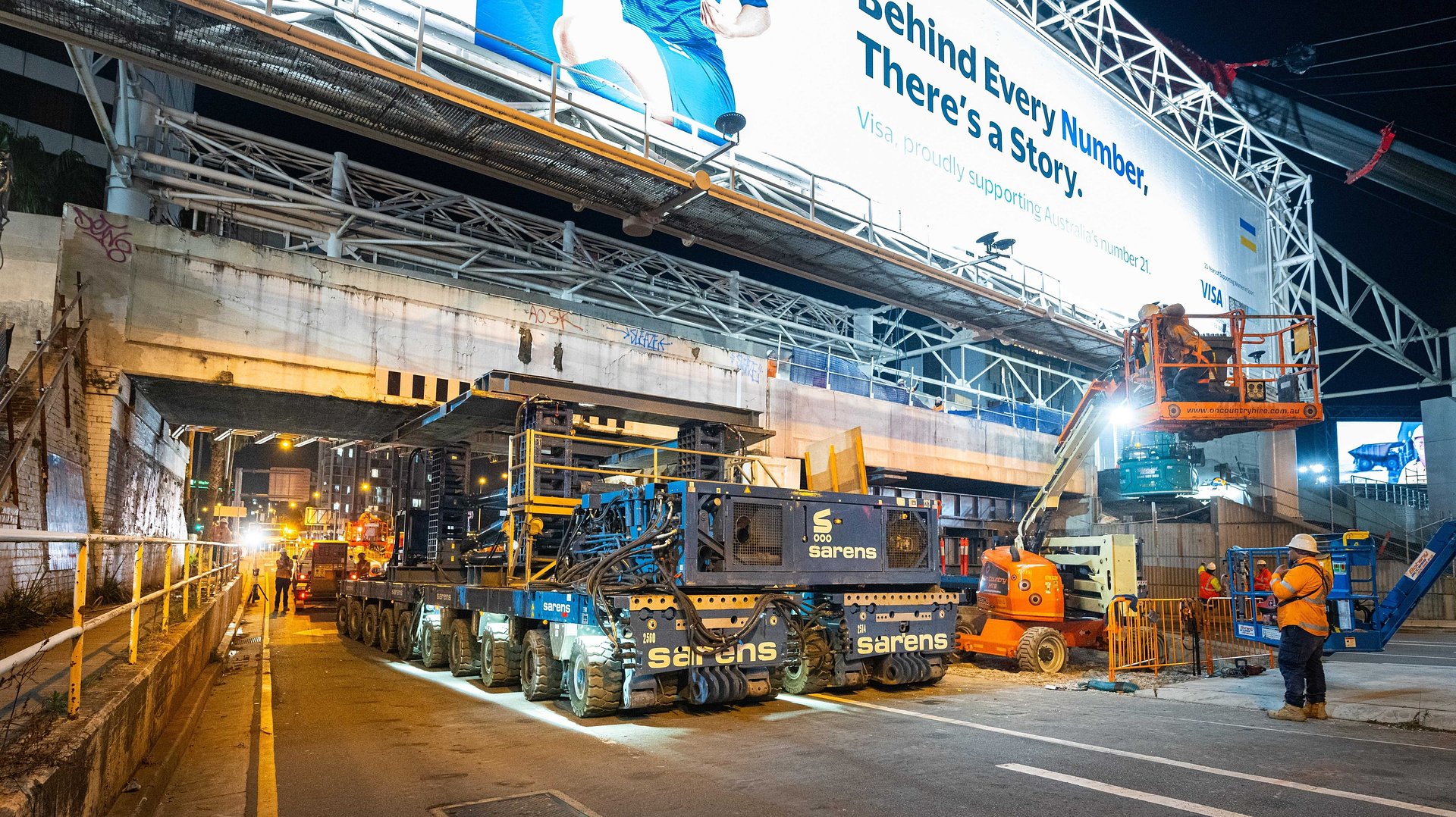
Sarens, world leader in heavy lifting, engineered transport, and crane rental services, has established itself as a strategic partner for the Australian construction sector thanks to its extensive experience in modular construction, which directly contributes to reducing development costs and project completion times. In fact, the company has already participated in multiple projects of critical importance to the country using its modular construction methodology, such as the Darlington Freeway bridge in Adelaide, where it was responsible for installing a 3,000-ton section using 132-axle lines SPMTs (Self-Propelled Modular Transports). Sarens has also participated, among others, in the Parramatta Light Rail project in Sydney, handling the engineering planning and installation of a 1,425-ton steel arch bridge over James Ruse Drive within an 8-hour construction window.
This initiative to contribute to a cleaner and more efficient construction sector is part of the country’s broader effort toward the energy transition. Thus, one of the pillars on which this transition will be based in the coming years will be wind energy production, both onshore and offshore, which will ultimately contribute more than $40 billion to the country’s GDP in the coming years. In the case of offshore wind alone, more than 26 GW of clean energy is expected to be generated by 2030.
In this highly demanding environment for the sector, Sarens has established itself as a strategic partner by leveraging its international expertise in the development of both onshore and offshore wind projects, thanks to its direct contribution to reducing development costs and construction timelines. In fact, it has already participated directly in strategic projects for the country’s energy sector, such as the Sapphire Wind Farm in New South Wales, where the company was responsible for installing the tallest turbine towers in all of Australia at the time; in Phases II and III of the Hornsdale Wind Farm in Jamestown, through the installation of 67 turbines; and at the Collgar Wind Farm in Merredin, with the installation and transport logistics for 111 Vestas V90 turbines.
According to Willem Jobse, Regional Director of Sarens in Oceania, “Australia is at a pivotal moment in its history thanks to its firm commitment to energy efficiency. Therefore, all sectors involved, from construction to power generation, must work with the utmost efficiency to achieve the government’s goals. At Sarens, we are very proud to be able to contribute our international experience gained over the past 70 years to ensure that the projects in which we participate are carried out effectively, in the shortest possible time, and with a commitment to reducing their environmental footprint.”
About Sarens
Sarens is the global leader and reference in crane rental, heavy lift and engineered transportation services. With state-of-the-art equipment, value engineering, one of the world's largest inventories of cranes, transporters and special rigging equipment, Sarens offers creative and intelligent solutions to today's heavy lifting and engineering transport challenges.
With more than 100 entities in 65 countries operating without borders, Sarens is an ideal partner for small to large-scale projects. Sarens currently employs 5,000 highly qualified professionals who are ready to serve the needs of any client worldwide and in all market sectors. https://www.sarens.com/