
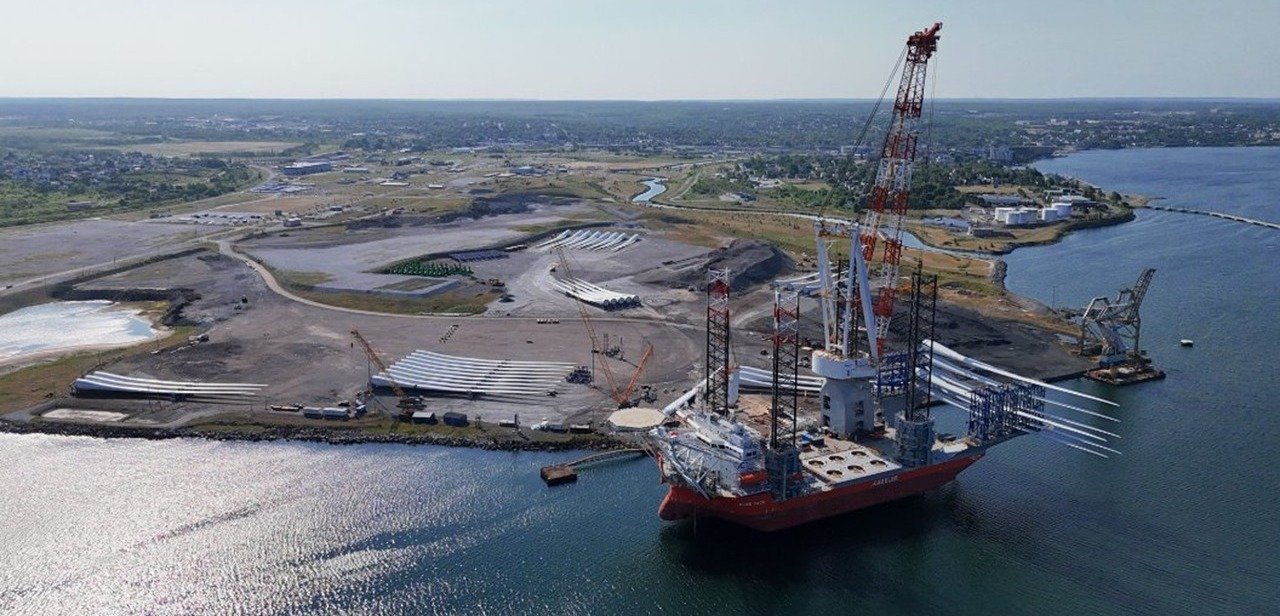
The port, which features a 350-meter (1,170-foot) berthing quay and over 44 hectares (110 acres) of land for component marshalling, is already a strategic stopover point for offshore wind projects in the northeast of the continent. It is currently considered one of the top 10 key ports for the North American offshore industry.
Sarens has successfully bridged the gap between legacy breakbulk site and the future of offshore wind. By applying specialized lifting methodologies and SPMT transport solutions, Sarens transformed an aging steel-industry quay into a top-tier maritime terminal. This project demonstrates how engineered load-spreading can bypass the need for massive capital investment, allowing 2,000-tonne components to be marshalled on existing ground, accelerating the timeline for the Eastern Seaboard’s energy security.
Located in Sydney, Nova Scotia, Canada, the Atlantic Canada Bulk Terminal (ACBT) has undergone a significant transformation to adapt its facilities to the evolving needs of the offshore wind industry. This evolution is vital for future Canadian Offshore Wind developments, such as Nova Scotia Wind West. Consequently, the terminal has shifted from a facility dedicated exclusively to the steel industry and material storage to become one of the most important strategic hubs in the North Atlantic.
Sarens, world leader in heavy lifting, engineered transport, and crane rental services, identified this opportunity early on. Sarens worked directly with the port owner to adapt Atlantic Canada Bulk Terminal to industry requirements. This specifically involved ensuring the quayside could facilitate safe operations for the loading and unloading of wind turbine blades and massive offshore foundation piles, some of these components exceeding 1,900 tonnes in weight and 100 meters in length each.
As a first step, the Sarens engineering team conducted a meticulous ground study to guarantee that heavy machinery could be positioned without the risk of subsidence or unwanted displacement. Subsequently, a large-capacity crawler crane was mobilized to the site, rigged with a "Superlift" tray to balance the weight. Through sophisticated load-bearing mitigation, the team achieved optimal weight distribution across the pier.
As a result of these efforts, it was successfully proved the port’s high-capacity LoLo (Lift-on/Lift-off) capabilities by loading wind turbine blades in tandem with specialized offshore wind installation vessels. Sarens also transformed the quay into a RoRo (Roll-on/Roll-off) facility. This allowed for more efficient transport methods using SPMTs, enabling Sarens to manage the unloading and movement of the large and lengthy components from specialized heavy transport vessel.
According to Robert Eykhout, Project Sales Manager at Sarens, who was commercially and technically responsible for these logistics solutions and the port’s development: This strategic project has been quite a challenge for us. Beyond the complexity of moving ‘frangible giants,’ we needed to demonstrate in record time that existing, privately owned infrastructure could accommodate parts weighing thousands of tonnes without crumbling under the pressure, providing a rapid solution to a growing market. By applying sophisticated engineering and load-spreading techniques, we proved that this terminal could be transformed into a world-class offshore hub without the need for hundreds of millions in infrastructure upgrades or a dependency on government funding. We thank Atlantic Canada Bulk Terminal for their trust in our expertise, and we look forward to collaborating on new strategic projects, such as Nova Scotia Wind West, in the coming years.”
Beyond its industrial significance, the ACBT adaptation has bolstered the local economy. In addition to the Sarens personnel stationed on-site for the past two and a half years, the crews of specialized vessels, which can house more than 150 workers simultaneously, have had a decisive impact on hundreds of local hospitality businesses. Their presence has supported local restaurants, labor, and hotels while utilizing local services and consumables to facilitate the operation.
Sarens has extensive international experience in marshalling solutions for offshore wind farm developments, having contributed to major French installations such as Fécamp, Saint-Nazaire, and Provence Grand Large. Sarens also managed the lifting and transport of foundation bases for the Saint-Brieuc offshore wind farm off the Brittany coast, handling loads over 1,150 tonnes. More recently, Sarens has been actively involved in the reception and loading of monopiles and turbine components for the turbines at the Coastal Virginia Offshore Wind farm in the US. Sarens also spearheaded the marshalling and installation of 62 monopiles at the Moray West offshore wind farm, each weighing up to 2,000 tonnes, representing the largest and heaviest XXL monopiles ever handled in the UK.
About Sarens
Sarens is the global leader and reference in crane rental, heavy lift and engineered transportation services. With state-of-the-art equipment, value engineering, one of the world's largest inventories of cranes, transporters and special rigging equipment, Sarens offers creative and intelligent solutions to today's heavy lifting and engineering transport challenges.
With more than 100 entities in 65 countries operating without borders, Sarens is an ideal partner for small to large-scale projects. Sarens currently employs 5,000 highly qualified professionals who are ready to serve the needs of any client worldwide and in all market sectors. https://www.sarens.com/