
The Canadian Construction Association (CCA) is considering infrastructure investments of around $115 billion.
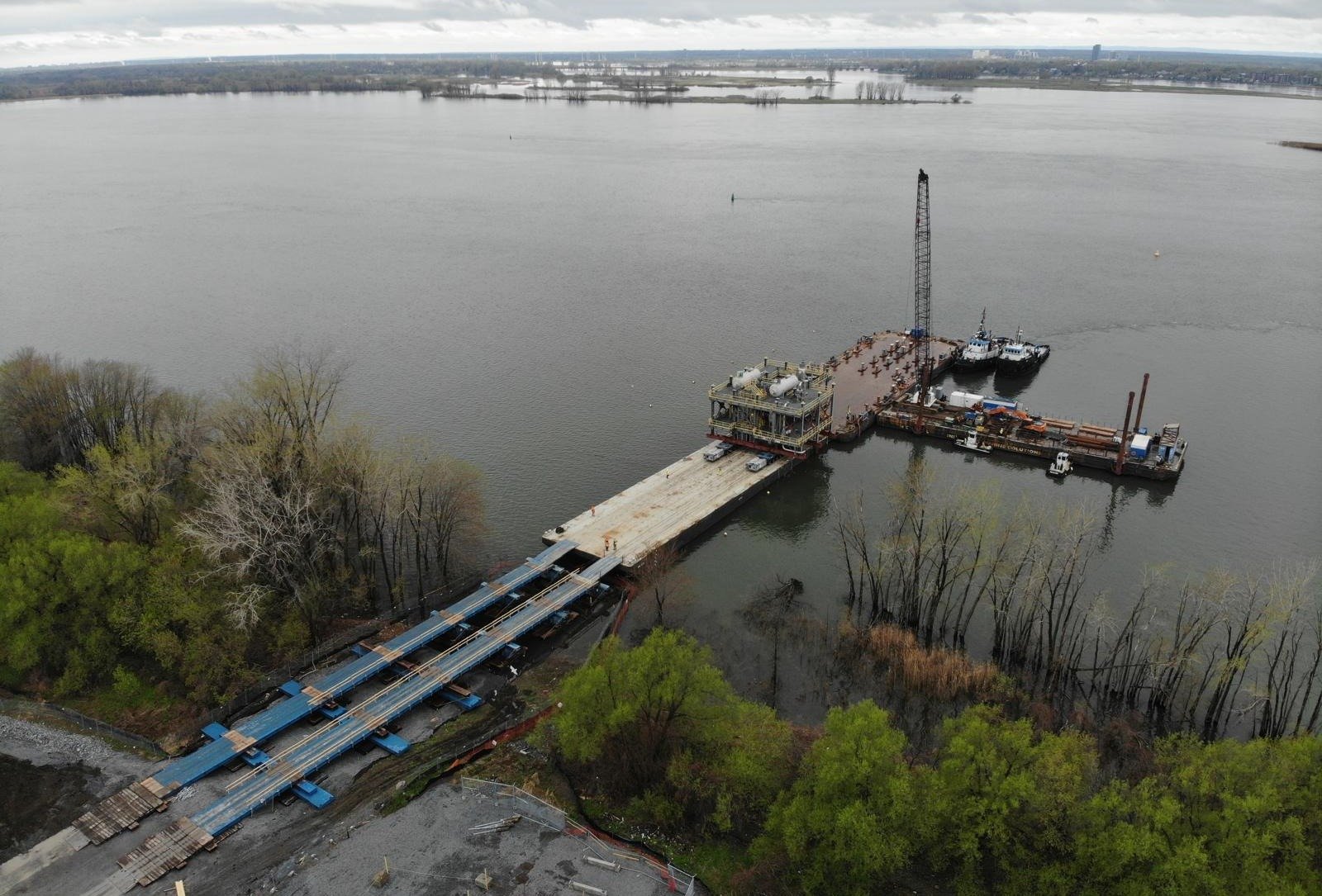
Sarens continues to contribute to the sector by building a 60-metre temporary bridge at the Port of Bécancour in Québec, Canada.
The project required the mobilisation of a large number of resources, including 38 SPMT lines, six ballast pumps, 450 concrete blocks and 500 tons of steel and platforms for the temporary bridge.
The construction sector in Canada is showing sustained growth, with an increase of 3.9% in 2025, after recording a compound annual growth rate of 5.8% between 2020 and 2024. Forecasts point to reaching approximately CAD 261.30 billion in 2029, at an average annual growth rate of 3.2% for the residential, commercial, industrial and infrastructure sectors, driven mainly by intense urban construction activity. In light of these figures, the Canadian Construction Association (CCA) has welcomed the Canadian federal budget, which includes infrastructure investments of around CAD 115 billion, of which CAD 51 billion will be allocated to local projects such as housing and transport, consolidating construction as a key pillar of economic growth in the country.
In this context of growth in Canada's civil construction industry, Sarens, world leader in heavy lifting, engineered transport and crane rental services, continues to contribute to the sector, demonstrating its ability to deliver under demanding conditions. Sarens recently completed the construction of a temporary bridge in Quebec, Canada, which involved the transport of nine large equipment modules and a lifting frame, with a tight schedule and significant challenges on site. Rapid mobilisation, precise engineering planning, and disciplined execution enabled safe and efficient delivery, highlighting Sarens' expertise in coordinating complex projects that require both advanced engineering and logistics.
To execute the project, Sarens received the cargo at the Port of Bécancour, where each module was unloaded and staged using a purpose-engineered load distribution solution developed to address the port’s low allowable ground pressure. The modules were then shipped by barge to the construction site in five separate voyages, with two modules per barge. A 60-metre temporary ramp and bridge system was installed to connect the shoreline to a grounded barge, allowing the modules to be unloaded at the site in a controlled manner despite restricted access and challenging riverbank conditions. Trailer positioning varied by module, and the ramp and bridge system was engineered to accommodate these different load cases without impacting operations, ensuring structural integrity and efficient execution.
The project required the mobilisation of a large amount of resources, including 38 SPMT lines, six ballast pumps, 450 concrete blocks and 500 tons of steel and platforms for the temporary bridge, all meticulously planned, sequenced and positioned. To achieve this, Sarens' global team worked in shifts, coordinating engineering, maritime logistics and transport to maintain the pace of work without interruption, even in the face of persistent rain that affected the site. Through meticulous supervision, the team was able to deliver the ten units without delays or setbacks, highlighting not only their technical expertise but also their ability to adapt and execute the project with maximum safety in complex conditions.
According to Gilles Emond, Sarens VP of Sales and Business Development, "our participation in this project in Québec demonstrates how Sarens combines technical expertise, precision engineering and logistical capabilities to execute complex works in challenging conditions. The construction of the temporary bridge and the mobilisation of large equipment modules required exhaustive planning, coordination between different teams and the use of state-of-the-art lifting and transport technology. This type of project not only reinforces our position as a world leader in heavy lifting and special transport solutions, but also demonstrates how we contribute to the development of civil infrastructure in Canada, supporting the growth of the sector and the local economy".
Sarens has extensive experience in the civil engineering sector in Canada, backed by its team's in-depth knowledge and its extensive portfolio of cranes and modular transport. Among the projects Sarens has been involved in are the Polaris CCS (Carbon Capture and Storage) project launched by Shell in Alberta, the upgrade of the heating, ventilation and air conditioning systems at Scarborough General Hospital, and the Finch West Station project, both in Toronto, where it installed 30 prefabricated roof panels weighing 3.25 tonnes each below ground level. Also notable is its participation in the renovation of Union Station, where the Sarens team carried out the lifting and subsequent installation of several 9.4-tonne iron beams for the “flying garden” connecting the north and south towers of the station.
About Sarens
Sarens is the global leader and reference in crane rental, heavy lift and engineered transportation services. With state-of-the-art equipment, value engineering, one of the world's largest inventories of cranes, transporters and special rigging equipment, Sarens offers creative and intelligent solutions to today's heavy lifting and engineering transport challenges.
With more than 100 entities in 65 countries operating without borders, Sarens is an ideal partner for small to large-scale projects. Sarens currently employs 5,000 highly qualified professionals who are ready to serve the needs of any client worldwide and in all market sectors. https://www.sarens.com/